
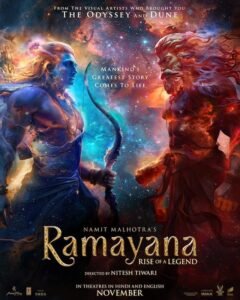
The Ramayana, alongside the Mahabharata, happens to one of the oldest and most significant foundational epics in sacred Hindu literature, and almost every Indian, irrespective of their religion, knows the story. I’ve personally watched numerous iterations of this epic for television and film since my childhood, some good, some bad, some enacted by kids, some animated, but nothing has been made on a scale of this big-screen version. It’s also one of the biggest attempts to take an Indian epic to a global audience, with the film releasing in about 40 languages worldwide. So was I looking forward to watching this film? Yes, big time. But does this version live up to the story we all grew up with?
Story, Screenplay and Direction
Director Nitesh Tiwari, reportedly started working on the adaptation back in 2019, alongside co-screenwriter Shridhar Raghavan. Thanks to the scale and production, they had everything in place to make this one of the best adaptations, and something India could genuinely showcase to the world. But while the film is officially titled Ramayana: Rise of a Legend, for a viewer unfamiliar with the story, they’ve made it surprisingly difficult to identify who the “legend” actually is, since so much of the runtime is devoted to Ravana.
Yes, it is important to establish Ravana’s character, but the context and details around everything else could have been better set up. The long prologue about Ravana left little room to properly cover key details about Vishwamitra, the Swayamvar, the Ikshvaku promise, and Dasharath’s curse. What little time they got felt rushed. There was so much they could have done instead of spending it on the long prologue, and close to 30 minutes in the second half on Vidyutjihva.
Because of this, the potential to develop Rama and Sita is lost entirely. There was so much more depth Tiwari could have added to their arcs. In Adipurush, Om Raut made a similar mistake, showcasing Ravana as menacing and great without ever establishing Rama’s greatness on screen, apart from elevating his character. Tiwari falls into the same trap here. What makes it worse is that, despite all that screen time, Ravana still ends up as the symbol of ultimate evil, even though he is not purely evil in a one-dimensional sense. Tiwari tried to touch on this in a brief episode, but by then, he’d already set the narrative.
Nevertheless, apart from the lack of emotional depth in a few episodes, Tiwari does a solid job with the direction. It takes courage to helm a film of such epic proportions, and he proves he’s a director with that calibre. Scene to scene, the screenplay by Tiwari and Raghavan is neat. The problem is what it chooses to spend its time on.
Acting
Ranbir Kapoor gives Rama his full effort, and you can see it, which is party the problem. He looked a touch too old for the role in places, and some of the early scenes felt like he was straining for gravitas rather than carrying it. Sai Pallavi, on the other hand, is perfect as Sita. She brings warmth and honesty to the role, but her wardrobe and sarees as the princess, didn’t match the grandeur around her.
Yash is menacing and magnetic, but the writing kept him in a fairly one-note “ultimate evil” lane, without giving him any opportunity to showcase his actual potential, beyond physical presence. Ravie Dubey brings welcome humor as Lakshmana, Rakul Preet Singh is neat as Surpanakha, and Shobhana was underutilised as Kaikasi. Rest of the cast is alright.
Technical Aspects
The best aspect of the film, however, is its technical side. Music and background score by A. R. Rahman and Hans Zimmer are definitely among the standouts. While there are not a lot of songs in the movie, the background score is on par with the best out there. I do think they should have come up with more standout tunes, as a single theme was used in multiple episodes.
Editing by Huzefa Lokhandwala is decent, but like I said earlier, some of the sequences showcasing Ravana’s might should have been trimmed. The film’s pacing was uneven at times. Cinematography by Pankaj Kumar and Mahesh Limaye is excellent. While most of the film relies on CGI and blue screens, they still do a remarkable job behind the camera. Production design, sets, and the VFX are all exceptional. Some of the sequences, especially the battle between Jatayu and Ravana, are visually breathtaking!
Is it worth your time and money?
Absolutely. I know that I went on a rant, but all qualms aside, Ramayana: Rise of a Legend is a commendable effort to take this Indian epic onto the world stage. The film is delivered on a larger-than-life scale and is spectacular on screen.
Worth mention: The visually stunning episodes and action sequences.
Acting: 8/10
Story-Screenplay-Direction: 7/10
Technical Aspects: 9/10
Verdict: 8/10
PS: I watched it in 3D IMAX and wasn’t disappointed. The visual grandeur in particular works best on the biggest screen you can find.
On another note, I found Christopher Nolan’s The Odyssey lacked the context needed to establish its characters. I actually had to Google who some of them were while watching. Is this becoming a theme with big epics, or am I the only one finding this odd? 🤔
